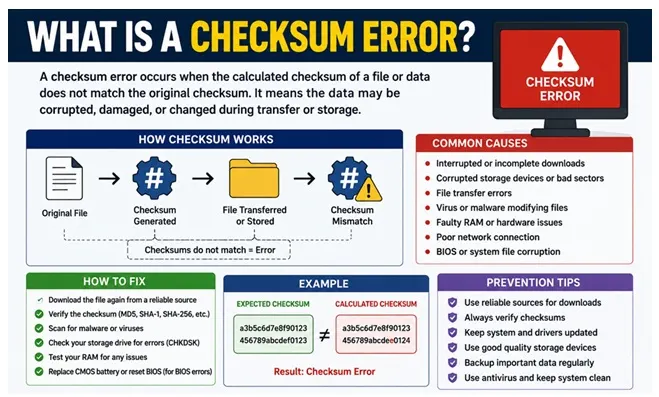
A checksum error is a common laptop mistake that happens when the calculated checksum of a report or data block does not match its anticipated value. In clean phrases, it means the device has detected that the data might have been modified, broken, or corrupted in the course of storage or transfer.
Checksum errors can appear while downloading files, installing software, updating your operating system, copying documents to a USB drive, extracting ZIP files, or perhaps for the duration of laptop startup. While they may seem alarming, many checksum errors may be resolved with a few troubleshooting steps.
What Is a Checksum?
Before understanding a checksum error, it is vital to comprehend what a checksum is.
A checksum is a very precise string of numbers and letters generated from a report the usage of a mathematical algorithm. Think of it as a digital fingerprint.
When a report is created, its checksum is calculated. Later, whilst the document is transferred or downloaded, the checksum can be calculated all over again. If each checksum value matches, the file is taken into consideration complete and unchanged. If they differ, the gadget reviews a checksum error.
What Is a Checksum Error?
A checksum error occurs when the checksum generated from the current record does not match the original checksum.
This commonly shows that:
- The file is corrupted.
- The download was incomplete.
- Data was modified at some unspecified time in the future after the switch.
- Storage media has errors.
- Memory or hardware problems affected the information.
The mistake no longer constantly implies the file is risky; however, it does mean that the record can’t be definitely depended on till the problem is resolved.
Common Causes of a Checksum Error
Several elements can cause a checksum error.
1. Corrupted Downloads
If your internet connection is interrupted at the same time as downloading a report, the downloaded version may additionally end up incomplete or damaged.
2. Faulty Storage Devices
Bad sectors on hard drives, SSDs, USB drives, or memory cards can corrupt stored data.
3. RAM Problems
Defective reminiscence modules might additionally modify data at the same time as it’s being processed, resulting in checksum mismatches.
4. Virus or Malware
Malicious software can modify files without your knowledge, causing checksum verification to fail.
5. Damaged ZIP or Archive Files
Compressed documents can also become corrupted in the course of download or transfer.
6. BIOS Checksum Error
Sometimes the motherboard indicates a BIOS checksum errors within the direction of startup. This typically takes place due to the following:
- CMOS battery is dead
- BIOS settings have become corrupted
- BIOS replacement failed
7. File Transfer Errors
Power interruptions or risky connections during file copying can damage files.
Common Checksum Error Messages
You may additionally encounter different versions of checksum errors, including:
- Checksum mistakes detected
- File checksum mismatch
- MD5 checksum failed
- SHA-256 verification failed
- BIOS ROM checksum mistakes
- ZIP checksum mistakes
- CRC checksum errors
- Checksum verification failed
Although the wording differs, the which means is generally the same: the record’s integrity cannot be shown
How to Fix a Checksum Error
1. Download the File Again
The simplest solution is downloading the file again from a reliable internet site.
If feasible:
- Use a strong internet connection.
- Avoid pausing downloads.
- Use a trusted download supervisor.
2. Verify the Checksum
Many software program builders post checksum values together with:
- MD5
- SHA-1
- SHA-256
- SHA-512
After downloading the document, test its checksum with the reliable rate. If they are in order, the file is undamaged.
3. Scan for Malware
Run a full antivirus test to ensure malware has not changed your documents.
4. Check Your Storage Drive
On Windows:
- Open Command Prompt as Administrator.
- Type:
chkdsk C: /f /r
Replace C: with the appropriate stress letter.
This command tests for bad sectors and the Renovation Record Tool errors.
5. Test Your RAM
Faulty RAM can cause random checksum errors.
Windows consists of a incorporated Memory Diagnostic Tool:
- Press Windows + R
- Type mdsched.Exe
- Restart the computer
The device will automatically check the memory.
6. Replace a Weak CMOS Battery
If your PC shows a BIOS checksum error at some stage in startup, replacing the CMOS battery frequently solves the problem.
7. Reset BIOS Settings
Incorrect BIOS settings can also cause checksum errors.
Resetting the BIOS to its default settings may additionally resolve the problem.
8. Update BIOS Carefully
If the BIOS firmware itself is corrupted, installing the latest version from the motherboard manufacturer’s valid website page may also help.
Be cautious throughout BIOS updates because of the truth interrupting the device can damage the motherboard firmware.
How to Verify a File Checksum
Windows customers can verify checksums using PowerShell.
Open PowerShell and run:
Get-FileHash "C:Downloadsfilename.Exe"
The generated SHA-256 hash can then be as compared with the checksum supplied via manner of the usage of the software program software developer.
If the values are equal, the document has not been changed.
Can a Checksum Error Damage Your Computer?
A checksum error itself does not harm your computer.
Instead, it serves as a warning that something may be incorrect with the file or storage medium. Ignoring checksum mistakes can bring about:
- Failed software program installations
- Corrupted documents
- System crashes
- Boot troubles
- Data loss
Therefore, it is also includes excellent to identify and resolve the cause in advance than the use of the affected document.
How to Prevent Checksum Errors
You can reduce the opportunities of checksum errors by following these high-quality practices:
- Download software program software software most effective from relied on internet web sites.
- Verify checksums each time they’re supplied.
- Use reliable antivirus software.
- Keep Windows and drivers up to date.
- Safely eject USB drives before removing them.
- Regularly take a look at your hard stress for mistakes.
- Replace aging storage devices while critical.
- Keep backups of critical files.
- Use an uninterruptible power supply (UPS) in case you reexperience common power outages.
Checksum Error vs CRC Error
Although those terms are regularly used interchangeably, they may be barely different.
| Feature | Checksum Error | CRC Error |
|---|---|---|
| Purpose | Detect data corruption | Detect transmission errors |
| Algorithm | Simple checksum or cryptographic hash | Cyclic Redundancy Check |
| Common Use | File verification | Networks, storage devices, ZIP files |
| Accuracy | Good | Generally more robust for transmission errors |
Conclusion
A checksum error is a data integrity warning that indicates a file or storage block has changed all at once. It can result from corrupted downloads, failing storage devices, defective RAM, malware, or BIOS troubles. Fortunately, most checksum mistakes may be resolved with the aid of re-downloading the file, verifying its checksum, scanning for malware, checking your garage hardware, or changing a inclined CMOS battery if the difficulty takes location inside the course of startup.
Understanding how checksum verification works allows you to ensure that your files stay accurate, steady, and loose from corruption. Whether you are installing software, downloading updates, or transferring vital data, verifying checksums is a smooth but powerful way to defend your system
Frequently Asked Questions
1. What is a checksum error?
A checksum error occurs when the calculated checksum of a document no longer matches the anticipated checksum, indicating possible corruption or tampering.
2. Can a checksum error be fixed?
Yes. Common fixes encompass downloading the report another time, verifying its checksum, checking your storage pressure, checking RAM, and scanning for malware.
3. Is a checksum error due to a virus?
Not commonly. While malware can cause checksum mistakes, they may be more common as a result of corrupted downloads, storage problems, or hardware issues.
4. What causes a BIOS checksum error
A BIOS checksum error is frequently as a consequence of a prone CMOS battery, corrupted BIOS settings, or a failed BIOS update.
5. How do I take a look at a document’s checksum in Windows?
You can use PowerShell with the Get-FileHash command to generate a checksum and test it with the expected value.
6. Can I forget about checksum mistakes?
It’s no longer recommended. A checksum mistake shows that the document can be incomplete or corrupted, so you need to verify or update it earlier than using it.